Removal of the Elk Fence
In the year 2025, major changes in Point Reyes National Seashore (PRNS) occurred. The changes actually began on Monday, December 2, 2024, when the National Park Service (NPS) announced its decision to remove the 8-foot-tall woven wire elk fence that has kept the main tule elk herd imprisoned for 46 years in the “Tomales Point Elk Reserve” at the north end of Point Reyes National Seashore. This was the culmination of a lawsuit, and a related planning process, with 35,000 comment letters that were almost unanimous in demanding that the fence be taken down.
The Park Service had only one choice, really. The overarching duty of NPS under its 1916 Organic Act and the Seashore legislation is to protect natural resources such as the elk and yet the Park Service allowed about 500 elk locked up inside the enclosure to die due to starvation and dehydration during two recent droughts. The fence also violated the Wilderness Act by virtue of the Park Service having locked up wildlife inside a wilderness area when the statute obviously prohibits such treatment of wildlife.
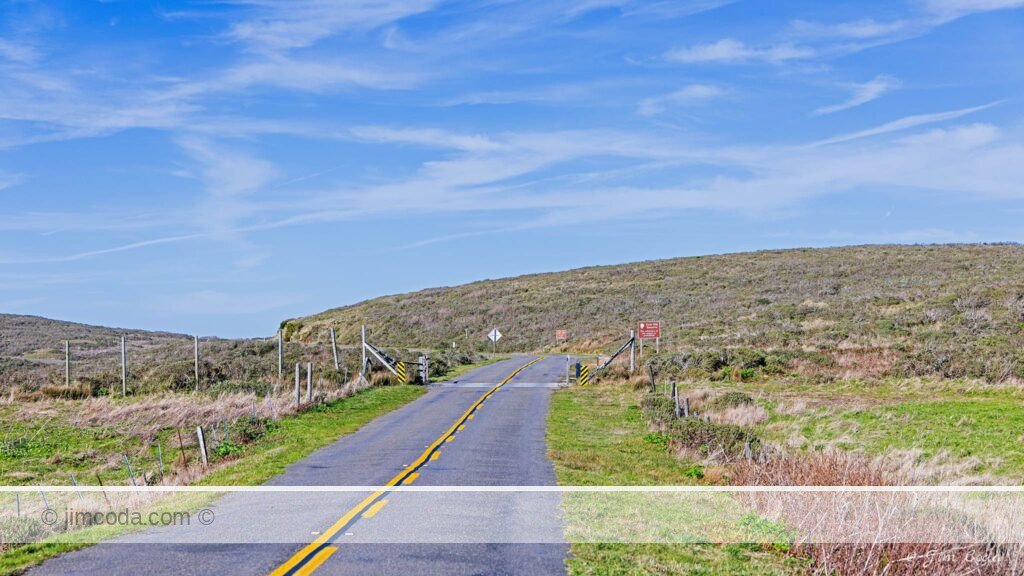
Two days after announcing its decision, NPS removed approximately 850 feet of elk fence on the Tomales Bay (right) side of the road. Some elk began leaving the old enclosure almost immediately. The photo below shows the entrance to the elk enclosure with the 8-foot woven wire fence and posts remaining on the left side of the road but removed on the right side of the road.
The Seashore ranchers quickly sued to stop the fence removal but dismissed their suit shortly thereafter because of the next thing that happened.
Ranching Lawsuit Settlement: Most Ranchers Agree to Leave Seashore for Money
On January 8, 2024, the Park Service announced the settlement of litigation regarding harm the dairies and beef ranches were doing to the natural resources of 18,000 acres of the Seashore and the northernmost 10,000 acres of the Golden Gate National Recreation Area (GGNRA). The GGNRA lands are managed by the Seashore under a cooperative agreement with GGNRA administrators because these lands lie adjacent to the Seashore and GGNRA headquarters is in San Francisco.
Under the settlement agreement, 12 of the 14 ranchers in the Seashore must leave the Seashore by April 7, 2026, in exchange for an undisclosed amount of money to be paid by The Nature Conservancy (TNC). Rumor has it that the total amount to be paid is roughly 30 million dollars.
Two ranching operations in the Seashore were allowed to remain as were all seven of the ranching operations in GGNRA. Two of the most important salmonid streams in the two parks pass through these GGNRA lands. The plaintiffs have never explained why they did not pursue the litigation as to the lands these nine ranches occupy in the two parks.
The Park Service bought these lands many decades ago. It has allowed these nine ranchers (as well as those that have signed settlement agreements and are finally leaving after many decades) to remain and do so at extremely low rents even though NPS has both the authority and the statutory duty to (a) protect and restore the Seashore lands and other natural resources and (b) collect fair market value for federal property it allows these private parties to use. NPS has never fully explained why it has allowed the ranchers to stay given the harm they have caused the Seashore’s natural resources and to stay essentially for free for these many decades. Even if NPS weren’t legally obligated to collect fair market value for the private use of these lands, it certainly has had the authority to do so. As the agency entrusted to manage these lands on the behalf of the United States, why wouldn’t it charge what such use is worth, especially if that income could be used for the management and protection of the Seashore’s resources, which are woefully underfunded?
While many cattle will be removed from the Seashore, the 282 cattle on those two Seashore ranches will remain. In addition, another 600 to 1,200 cattle will be brought in by TNC, as needed, for “targeted grazing.” Targeted grazing is designed to try to control non-native grasses, such as velvet grass, and to prevent native brush like coyote brush and yellow bush lupine as well as trees, from spreading into grasslands.
Cattle can restrict the spread of brush and trees. And tule elk have done a good job of that in the Tomales Point Elk Reserve where the elk have been locked up for these past 46 years. They can do the same for the rest of the Seashore. However, neither cattle nor elk can or will remove the non-native European grasses that the ranchers brought in to replace the native grasses that cattle loved so much they wiped them out long ago. NPS has a statutory duty to protect and restore native grasses and other natural resources.
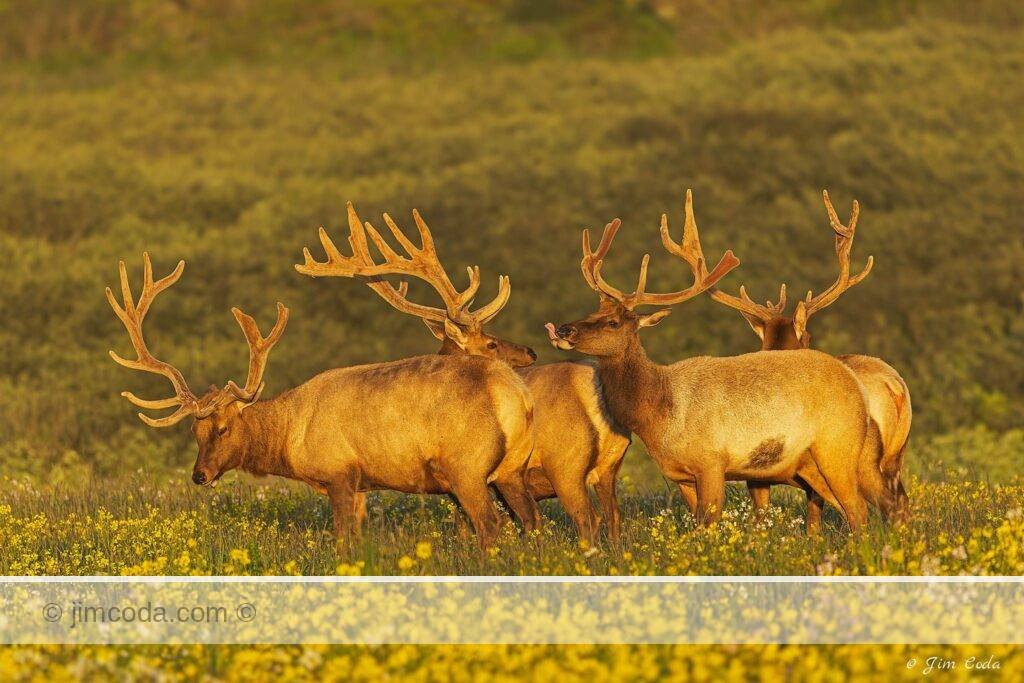
The bull elk below are grazing on Seashore land called the J Ranch, which is adjacent to the elk enclosure, and looking well nourished. I would prefer it though if they had the opportunity to graze on native vegetation and not on the non-native wild radish or mustard or both seen in this photo brought in by the ranchers for silage. The bad thing about silage is that it is cut in the spring when it’s green. Unfortunately, that’s when some birds use it for nesting and the nestlings get chopped up. Deer also often choose silage fields for birthing, which leads to fawns getting chopped up. There are devices called “flushing bars” that help in avoiding that, but I’ve never seen them used on the ranches in the park. I’ve always wondered why the National Park Service hasn’t required flushing bars since the Seashore is part of the National Park System and NPS is responsible for management of the land.
Converting the ecosystem of the ranching area to what it was before the cattle arrived and wiped out the native vegetation is a Herculean task that I doubt will ever be accomplished. The non-native grasses and other non-native vegetation that covers most of the ranching area isn’t going anywhere willingly.
Two Remaining PRNS Ranchers Sue to Replace the Ranchers Who Were Paid to Leave with Other Ranchers
Not content with simply being allowed to continue ranching under the settlement, the two remaining Seashore ranchers, Bill Niman and Dave Evans, want new ranchers brought in to occupy the lands that the 12 ranchers who are leaving once occupied and were paid millions of dollars by TNC to do so. In their attempt to accomplish this, they sued NPS in late February basically claiming NPS violated NEPA in entering into the settlement without revisiting the NEPA process because the settlement and its impacts weren’t considered as an alternative in the earlier EIS. However, the EIS considered reductions in ranching as well as the total elimination of ranching as alternatives. That is all that is required. The three environmental plaintiffs in the original litigation that resulted in the settlement have intervened.
Even if the settlement were somehow set aside, that would simply reinstate the litigation that was settled. TNC would intervene and/or file a separate suit. I would hope that if the settlement were somehow set aside, Messrs. Niman and Evans would be treated the same as everyone else. Having them remain is not something most environmentalists want. The same holds true for the continuation of ranching in the GGNRA which adversely affects natural resources in general and high-quality salmonid streams in particular.
A Suit Was Brought on Behalf of People Living in the Houses on Several of the Ranches
At about the same time Niman and Evans sued, a suit was brought against NPS on behalf of people living in houses on several of the ranches. The three plaintiffs moved to intervene in that case as well. I don’t see any basis for those residents, as employees of the ranchers and with no legal relationship with NPS, to have any legal basis to prevail against NPS. The settlement requires that they leave the Seashore by March 1, 2026. It also provides some assistance to them, or at least to those that actually worked at the ranches. The county of Marin is also providing some housing relief. I understand that some residents have left the Seashore already.
The Slow but Steady Winding down of the Point Reyes Ranches
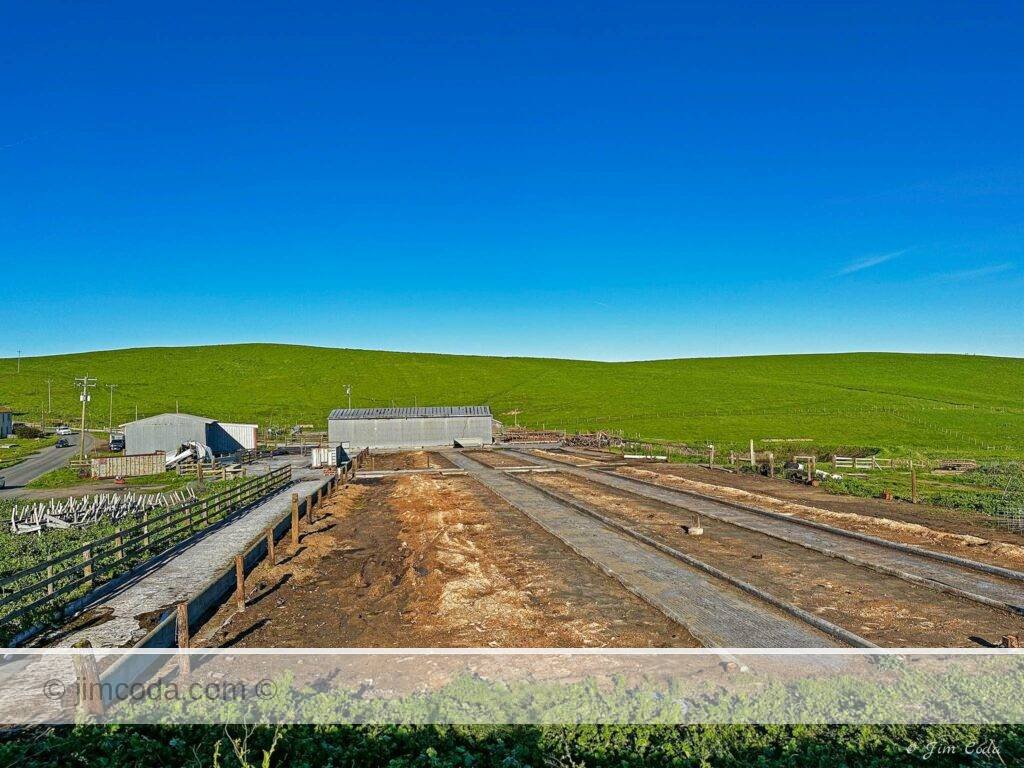
As stated earlier, the settlement requires the ranchers to be out of the Seashore by April 7, 2026. My last trip out there was on December 29, 2025. Starting at the south end of the pastoral zone (the end of Sir Francis Drake Blvd.), the A Ranch (Nunes) removed all its cows some weeks ago. The ranchers are required to accomplish certain things before vacating. That includes cleaning out manure ponds and it apparently also includes the removal of certain buildings. The A Ranch has removed the old, dilapidated free-stall barns. See photo below.
Heading east on Sir Francis Drake Blvd., the next two dairies, (the B (Mendoza) and C (Spaletta) Ranches), got rid of their adult dairy cows and thus milk production ceased some time ago. Heifers are all that remain. I did not see any cows on the E Ranch. Its barn(s) are also in the process of being torn down and removed like at its other ranch (the A Ranch). The F and G Ranches (Gallagher and Lunny) vacated the Seashore some time ago. I don’t know that there has been any change at the D Rogers Ranch (Evans) which is very hilly especially near the ranch complex and Dave Evans is not leaving. Home Ranch seems to have a much-reduced number of beef cows. I only saw one bull and one cow, although it is also a hilly area.
Turning onto Pierce Point Road and the north ranches, I saw roughly 50 cows on the H Ranch. I didn’t see any bulls which I always see on the right side of the road. I didn’t see any beef cows on McClure’s I Ranch (formerly a dairy), although, again, the hilly terrain could have hidden them. I saw some beef cows across the road from the J Ranch dairy (Kehoe) complex and more cows near the old elk reserve. I also saw about 75 elk on the J Ranch complex. I’ve been seeing them there near the ranch complex for many months. As for the K Ranch, I don’t recall seeing any cows, but that is also Dave Evans’ leased land, and I assume they were there and just not visible. I saw quite a few dairy heifers on the L Ranch. Heifers are all I’ve seen there for a few years. Finally, I don’t recall seeing any cows on the M Ranch, but again, it is a hilly area. According to an article in the October 22, 2025, edition of the Point Reyes Light, the reporter stated she saw some sheep, chickens and “about 150 perambulating heifers dotted the surrounding hills.”
In summary, the 12 ranchers are in various states of winding things down and leaving per the settlement. It looks like all of them will be out by the April 7 deadline.
2026 and Beyond
The Niman and tenant suits are still ongoing. I don’t expect them to prevail in any way. Attempts have been made to get Interior Secretary Burgum to do something to get what Niman and Evans want (replacement ranching) through their litigation, but I don’t see that happening. The settlement is locked up in a federal court judgment and even if that somehow came undone, that would just result in reinstituting the litigation.
That leaves future management of the lands and other resources to NPS, TNC, the Federated Indians of Graton Rancheria (which signed a cooperative agreement regarding management of the Seashore with NPS during the Biden Administration) and, finally, the public. (So, who is in charge of restoring the Seashore lands?)
As stated previously, National Park units are required to be managed primarily for the protection and restoration of natural conditions. In my opinion, cattle grazing will do nothing but preserve the status quo.
I understand that in 2026 there will be a public planning process for discussion and development of a management plan for restoring the ranching area to its native condition before cattle were introduced. This will be an opportunity to propose alternatives to simply using targeted cattle grazing to restore the Seashore. One thing I would like to see would be an experiment whereby different potential methods of restoration would be tried at separate sites. Some of the methods I believe should be considered are:
- targeted grazing by cattle,
- grazing by elk (which experiment already exists, namely the Tomales Point Elk Reserve),
- grazing by goats (unlike with cows and elk, their very acidic stomachs destroy seeds of most plant species, preventing those plants from re-growing (time to plant natives); goats are used by USFWS and NPS
- prescribed/controlled burns,
- mowing,
- herbicides,
- manual (pulling) weed removal, and
- a control area with no action taken.
Planting native grasses should be considered in conjunction with the above alternatives.
Finally, all the barbed wire fencing should be removed. Cattle should be controlled by GPS (aka “virtual fencing”) collars. TNC has produced an informative video promoting the use of GPS collars.
To the extent any barbed wire fencing is deemed necessary because of vehicular traffic, it should be limited to Sir Francis Drake Boulevard and Pierce Point Road, and it should be constructed and maintained in accordance with wildlife-friendly standards.


Barbed wire is a hazard to wildlife as shown in the above photos of two Point Reyes bull elk. Note how in the photo of the elk skull the wire across the bridge of its nose worked its way halfway through the lower jaw preventing the elk from eating or drinking and thus causing death by starvation and/or dehydration.
Comments on 2025 and the future?

This photo, along with all others now on my new website, is available to purchase as a high quality fine art print to hang on your home or office wall.







4 Responses
Excellent article.
A huge win for Point Reyes’ unique ecosystem and wildlife!
Remove remaining cattle and restore the National Seashore!
Hi Robert. Thanks for your comment. Yes, let’s hope things go well in 2026!
Great summary, Jim. All things considered, it would be a boon to Life on Earth if the “settlement” is liquidated, and the original lawsuit adjudicated fairly. The law is clear: all of the ranches in PRNS and GGRNA must be restored, which will save the public $30 million in blackmail fees. Plus, get rid of the pesky, meddlesome, pro-ranching, anti-environmental, corrupt TNC.
Hi Peter. I agree the settlement isn’t perfect, but barring some new enviro lawsuit we will have to make do with what we’ve got. I think we’ll learn a lot about TNC (and NPS) in the process. At least NPS is on a new and far better course now of restoring nature for most of the old ranching area.